
Behind the Characters — Episode 01
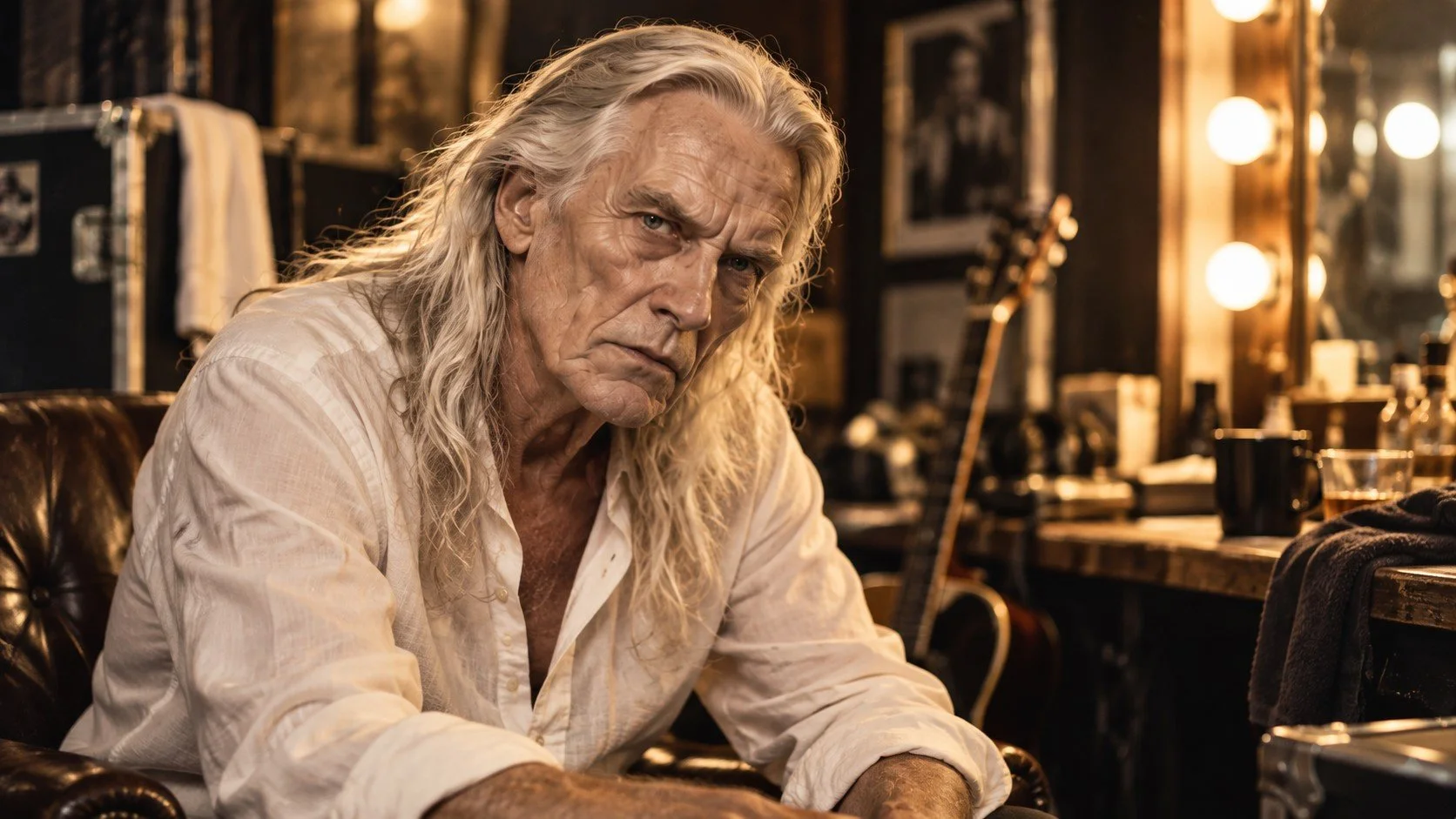
Johnas Blackrain: The Man Who Had Everything Except a Life
Behind the Characters — Episode 01
Why a seventy-year-old billionaire found his voice in acoustic blues.
Johnas Blackrain has a problem. Actually, he has several, although he would probably insist that most of them are caused by other people. He is seventy years old, enormously wealthy, spectacularly unpleasant, and the owner of one of the most extravagant private estates in North Carolina. His house contains priceless works of art, extraordinary technological inventions, and enough luxury to satisfy several generations of exceptionally demanding aristocrats. Yet Johnas is not a happy man. Far from it.
For nearly fifty years, he has lived according to a collection of rigid habits, carefully arranged routines, and personal rules designed to prevent the unexpected from interfering with his existence. Dinner must be served at precisely eight o'clock. Objects must remain exactly where they belong. The household staff must follow his instructions without question. Disorder is unacceptable, spontaneity is suspicious, and other people are generally a regrettable inconvenience.
But beneath this magnificent display of arrogance lies something considerably less amusing. Johnas is a profoundly lonely man. Fifty years earlier, the disappearance of Alma, the only woman he ever truly loved, brought his emotional life to a standstill. Everything that followed became an elaborate exercise in avoiding change. His immense fortune allowed him to construct a world in which almost nothing unexpected could happen. What he never understood was that he had also constructed his own prison.
Why the Blues?
When I began imagining how Johnas might express himself through music, I had no interest in giving him an extravagant orchestral arrangement or a sophisticated production worthy of his considerable bank account. Those would have reflected his wealth, but not his personality.
I wanted precisely the opposite: an intimate acoustic blues, a weathered male voice, and the unmistakable sound of acoustic Martin guitars.
The blues seemed particularly appropriate because it strips away the things Johnas uses to define himself. Money, status, possessions, power, and social superiority become irrelevant when a man sits down with a guitar and begins to tell the truth about his life.
And Johnas has spent an extraordinary amount of time avoiding that truth.
The opening verse of Six Dwarfs Blues immediately establishes the contradiction at the center of his existence. Johnas remembers sitting alone in his enormous house, counting his wealth and watching the clocks. Then comes the confession that defines the entire song: seventy years spent accumulating riches while slowly dying in perfect health.
It is a remarkably concise description of a man who has confused security with happiness and possession with living.
Six Damn Dwarfs
Then everything changes.
Six extraordinary visitors arrive at Blackrain Estate and proceed to violate practically every principle upon which Johnas has constructed his existence. They disrupt his routines, damage his possessions, challenge his authority, and turn his carefully controlled world into something resembling an expensive natural disaster.
For Johnas, this is initially an unforgivable catastrophe.
But the song introduces a transformation that the character himself would once have considered impossible. Somewhere between the destruction of his precious belongings and the collapse of his carefully maintained dignity, he begins to laugh.
Not because he has suddenly become cheerful or reasonable. Johnas Blackrain will probably never qualify as either. But because something has interrupted the long paralysis of his existence.
For the first time in decades, he is no longer merely preserving the life he has built. He is experiencing it.
The chorus carries this realization with characteristic Blackrain vulgarity and an almost reluctant sense of gratitude. The six intruders have destroyed his peace and wounded his pride, but they have also made him feel alive.
That contradiction is the emotional center of the blues.
The Things Money Cannot Buy
There is a reason I wanted this recording to sound intimate rather than grandiose. Johnas already possesses everything grandiose that money can purchase. Another magnificent performance would merely confirm his familiar world.
Instead, the song allows him to acknowledge its emptiness.
The bridge reduces his entire philosophy of existence to a few simple observations: money can purchase locks, luxurious beds, and expensive clocks, but none of these things can restore a life that has stopped moving forward.
For a man who has spent decades trying to control time through repetition, this is an uncomfortable discovery.
And perhaps the most surprising thing about Six Dwarfs Blues is that Johnas doesn't sound defeated. There is regret in his voice, certainly, but also humor, disbelief, and an unexpected sense of liberation.
He has lost control. The world has refused to obey him. His precious peace has been shattered.
And somehow, he has survived the experience.
More than survived it, in fact.
He has rediscovered something he thought was gone forever.
Listen to Six Dwarfs Blues
This is Johnas Blackrain speaking for himself, through a musical interpretation of the character he has become. His account is personal, emotional, and undoubtedly selective. As with all the recordings in The Blackrain Session, listeners are free to decide how much of his version they wish to believe.
What matters is that the man who once wanted nothing more than to be left alone has finally found something worth singing about.
And, naturally, he has found a way to complain about it.
Six Dwarfs Blues — Johnas Blackrain
GNOME RECORDS · The Blackrain Session
Behind the Characters explores the personalities of The Seven Magnificent Dwarfs through their musical identities. The Blackrain Session is a creative experiment conceived by Andrea Bigiarini, using generative AI to interpret the fictional characters of his novel.
Discover the complete Blackrain Session
Every character has a voice. Every voice has a story.