
BEHIND THE CHARACTERS - EPISODE 10
BEHIND THE CHARACTERS - EPISODE 10
Cayo Bolivar: Class Struggle, Mutants, and Rock 'n' Roll
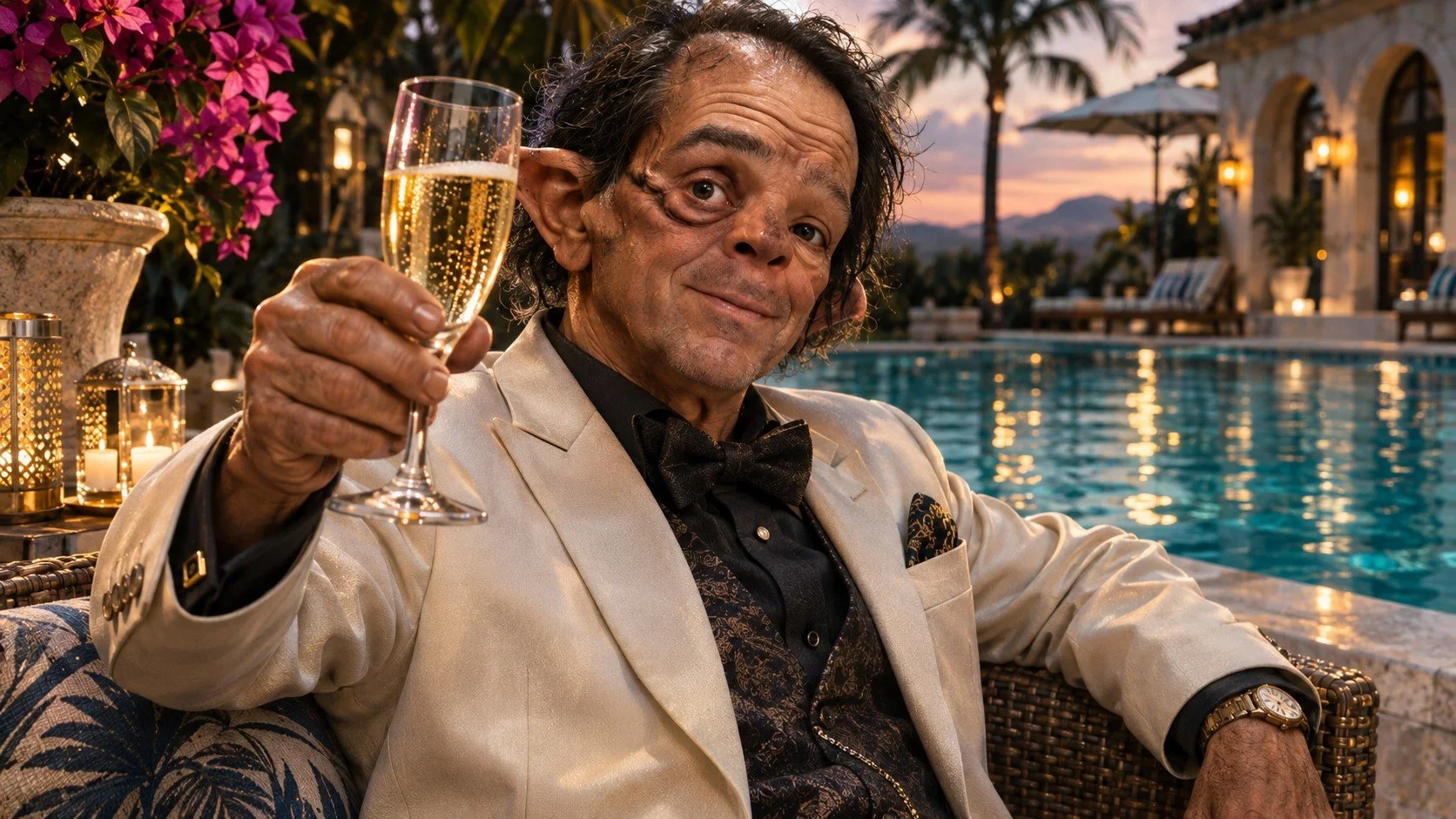
He's short, ugly, and has a face that looks like it lost an argument with evolution. But Cayo Bolivar possesses something many of his fellow mutants have long since abandoned: the ability to get outraged. A combative union representative, a worker in Ebenezer Halley's underground base, and a tireless defender of workers' rights, Cayo is one of the most unlikely characters in The Seven Magnificent Dwarfs. And now he even has a band: Cayo Bolivar and His Mutants, performing their wild and outrageous Bed-Frame Boogie.
Cayo Bolivar: A Brief Union Biography
More than 650 feet beneath Johnas Blackrain's mansion lies a world no labor inspector would ever want to visit.
Exhausting shifts, appalling working conditions, hazardous chemicals, psychopathic supervisors, and a reasonable chance of being eliminated simply for requesting a day off.
Welcome to Ebenezer Halley's underground base.
This is where Cayo Bolivar works. A short, rather battered-looking mutant with permanently filthy overalls and a facial expression that constantly alternates between righteous indignation and sheer terror.
Cayo isn't a general. He has no extraordinary powers, and he has absolutely no desire to conquer the world.
He'd settle for a decent collective bargaining agreement.
He's the representative of the M.W.L. — Mutant Workers' League, a labor organization dedicated to defending the rights of the base's employees. Not an easy assignment, considering that their employer is a megalomaniac determined to take over the planet.
But to Cayo, workers' rights are workers' rights.
Even when his supervisor, Prexlo Muertos, explains that this is hardly the time to discuss vacation days, benefits, and insurance because they're currently trying to conquer the world.
Our union representative refuses to be intimidated. He quotes articles, subsections, regulations, administrative directives, and provisions of the Mutant Workers' Statute with the enthusiasm of an attorney who has finally found someone willing to listen.
Unfortunately, Prexlo prefers a more hands-on approach.
And those hands are considerably stronger than Cayo's.
I created Cayo to introduce a perspective completely different from that of the heroic protagonists and traditional villains.
A character who experiences events from the bottom of the ladder, from the viewpoint of someone who has to work, obey orders, and preferably survive until payday.
Cayo is stubborn, pedantic, and frequently ridiculous. But he possesses one quality that shouldn't be underestimated:
He genuinely believes that even a mutant deserves to be treated with dignity.
The problem, naturally, is convincing the other mutants.
A Revolutionary with a Few Survival Problems
Cayo belongs to that category of idealists who firmly believe in their principles.
Especially until somebody pulls out a gun.
At that point, things become considerably more complicated.
Throughout the novel, Cayo finds himself in situations that put his convictions to the test. He discovers just how thin the line can be between defending a principle and being literally crushed by the machinery of power.
But beneath his bureaucratic language, endless references to union regulations, and revolutionary rhetoric lies a very simple question:
Why should some creatures have more rights than others?
It's a question that takes on a rather peculiar meaning in the world of The Seven Magnificent Dwarfs.
And I won't explore it any further, because I'd rather let readers discover what happens to our little union representative for themselves.
I'll just say that his career takes several decidedly unexpected turns.
Not all of them covered by his collective bargaining agreement.
Cayo Bolivar and His Mutants: Bed-Frame Boogie
When I decided to bring Cayo into the musical universe of The Blackrain Session, I asked myself a simple question:
What kind of music would a mutant union representative working deep beneath the Earth's surface perform?
The answer seemed obvious.
Boogie.
Not an elegant jazz ballad. Not a sophisticated orchestral arrangement. And certainly not a solemn revolutionary anthem accompanied by a chorus of workers with their fists raised.
I wanted something ramshackle, infectious, loud, and irresistibly entertaining.
A rhythm that brought to mind old American roadhouses, early rock 'n' roll, mercilessly pounded pianos, and that uncontrollable urge to dance that tends to strike precisely when somebody orders you to keep working.
That's how I imagined Cayo Bolivar and His Mutants, an unlikely musical outfit featuring our union representative and a few fellow mutants.
Their song is called Bed-Frame Boogie.
The title itself is practically a declaration of musical intent. Even an old bed frame can become the symbol of music born from the most unlikely objects.
After all, in an underground base where everything is rusty, patched together, or about to explode, using nothing but conventional musical instruments would almost seem wasteful.
The image I had in mind was a band capable of transforming its miserable workplace into an underground party.
The boss demands productivity?
The workers answer with rhythm.
The shift never ends?
Keep dancing.
The union demands a break?
Cayo grabs the microphone.
What I particularly enjoy is the contrast between Cayo in the novel, forever quoting rules and regulations, and Cayo the performer, who can finally forget about subsections and administrative directives and surrender himself to the boogie.
At least for a few minutes.
Because I'm fairly certain that once the concert was over, Cayo would immediately start arguing with the organizers about overtime pay.
The Right to Have a Good Time
There's a reason I wanted to give a song to a supporting character like Cayo Bolivar.
In The Seven Magnificent Dwarfs, heroes aren't the only ones with personalities, ambitions, and stories worth telling.
Even the most marginal characters have their own view of the world. And sometimes they're the ones who reveal its most interesting contradictions.
Cayo doesn't dream of glory, fame, or supernatural powers.
He dreams of better working conditions.
And, if possible, making it to payday alive.
With Bed-Frame Boogie, I wanted to give him something he rarely enjoys in the novel: a moment when he doesn't have to defend himself, justify his demands, or worry about his supervisor's reaction.
He can simply sing.
And get the other mutants dancing.
Of course, I know Cayo well enough to imagine that just before the final chorus, he might stop the music to announce another union demand.
"Comrades! After four bars of boogie, the regulations clearly entitle us to a paid break!"
Somebody should probably explain to him that rock 'n' roll doesn't work quite like that.
But I seriously doubt he'd listen.
Listen to Cayo Bolivar and His Mutants — Bed-Frame Boogie
A wild, irreverent boogie dedicated to the most unlikely union representative in Ebenezer Halley's underground base, from The Blackrain Session by GNOME RECORDS.
Discover The Seven Magnificent Dwarfs on Amazon
Behind the Characters — Exploring the stories, personalities, and music of the characters from The Seven Magnificent Dwarfs.
Andrea Bigiarini