
BEHIND THE CHARACTERS - EPISODE 03
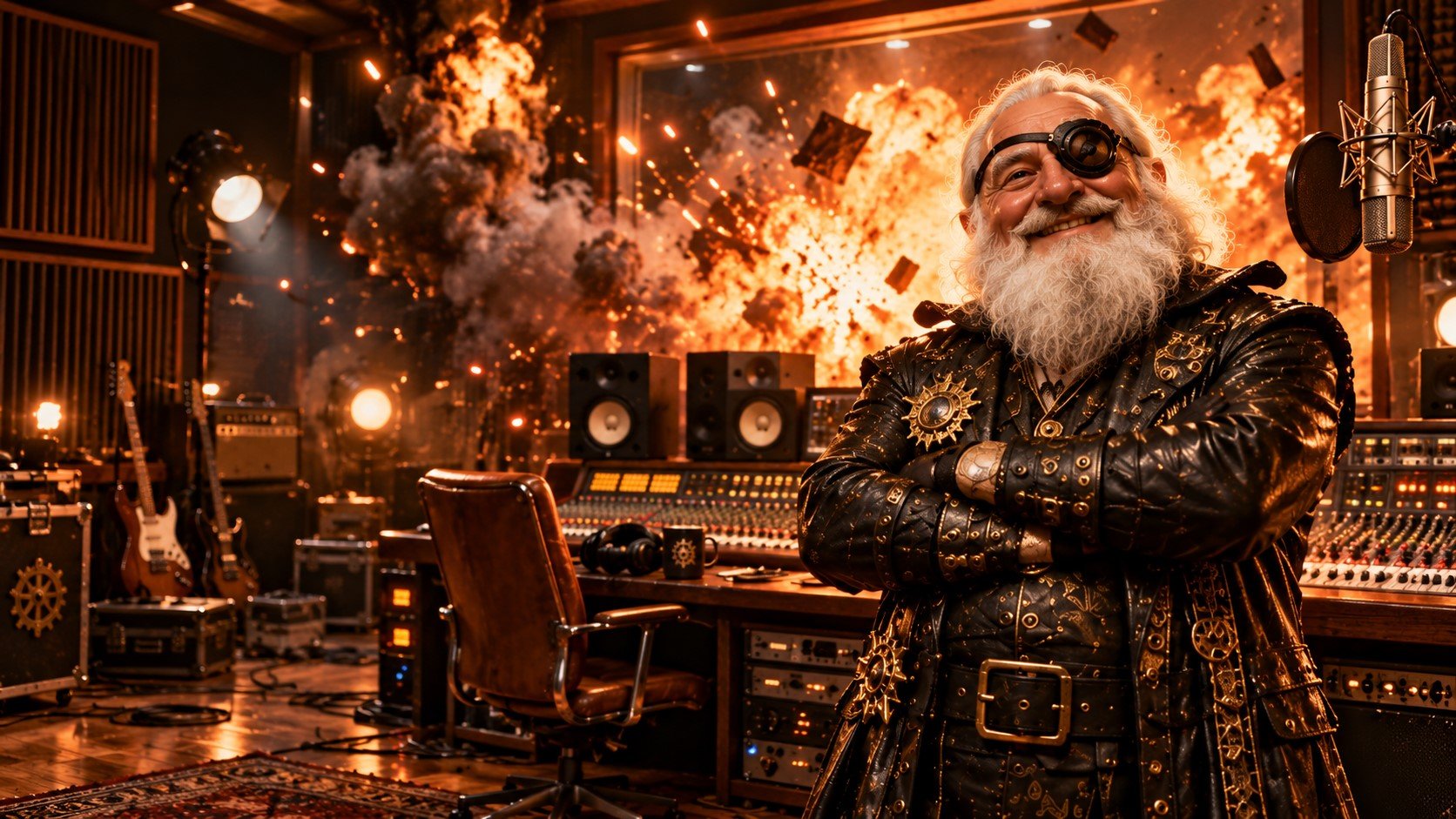
BEHIND THE CHARACTERS - EPISODE 03
Teophrastus “Teo-Bomb” Bombastus: Wisdom, Alchemy, and the Pleasure of Blowing Things Up
His name honors one of history's most celebrated alchemists. His nickname commemorates a childhood disaster. But behind Teo-Bomb lies something far more complex: a character for whom knowledge is the most dangerous form of power. And in “A Little Bit of BOOM,” he discovers the pleasure of turning even explosions into music.
It's entirely possible to spend a lifetime studying the mysteries of the universe, become one of the most respected masters of alchemy, earn the admiration of three kingdoms, and still be remembered for blowing up your parents' house.
That's exactly what happened to Teophrastus Bombastus.
In The Seven Magnificent Dwarfs, Teo-Bomb occupies a rather unusual position. He's the oldest member of the mission, the most authoritative, and perhaps the one whose abilities are least understood by the others. As Grand Master of the Varda Academy, he possesses knowledge that crosses the boundaries between science, magic, and natural philosophy.
And yet, long before becoming a living legend, he was a curious little boy who made a laboratory mistake of truly catastrophic proportions.
That contradiction is the best place to begin understanding him. Because Teo-Bomb isn't simply the wise old master entrusted with guiding a group of adventurers. Two seemingly incompatible impulses coexist within him: the desire to understand the order of the universe and the temptation to discover what happens when that order is violently disturbed.
A Name That Crosses the Centuries
The character's full name is Teophrastus Bombastus, and it wasn't chosen by accident.
His father, Astimius Farroldus, was a master alchemist descended from a family that had cultivated alchemy, astrology, and the esoteric sciences for generations. When his son was born, he named him in honor of Philippus Aureolus Theophrastus Bombastus von Hohenheim, better known as Paracelsus, the sixteenth-century physician, natural philosopher, and alchemist.
The choice establishes one of the most intriguing connections between our world and the fictional universe of the novel.
Paracelsus was a singular figure in the history of Western thought. He lived in an age when medicine, the study of nature, religion, astrology, and alchemical practice were not yet separated by rigid disciplinary boundaries. He challenged many of the established authorities of his time and emphasized the importance of direct experience in understanding natural phenomena.
But Paracelsus was also fascinated by what we would now place in the realm of the supernatural.
His writings on elemental beings include gnomes, creatures associated with the earth and the subterranean world. It's from this particular aspect of his work that I developed part of the mythology of The Seven Magnificent Dwarfs.
In the novel, I imagine that the relationship between Paracelsus and the Little Folk was more than philosophical speculation. The alchemist had actually discovered the existence of these beings and collaborated with some of them, helping develop knowledge that made travel between dimensions possible.
One of his collaborators was even an ancestor of Teo-Bomb.
Naturally, this belongs to the world of fiction. But the intersection between a real historical figure and an imaginary universe is precisely what makes the origin of Teo's name so interesting.
Teo doesn't simply inherit a family tradition. He inherits a conception of knowledge in which the universe isn't necessarily limited to what conventional instruments can measure.
For him, the boundary between the possible and the impossible is primarily the temporary boundary of human understanding.
And Then Came the BOOM
The most entertaining part of his name, however, comes from a decidedly less distinguished episode.
As a child, Teo decided to mix several chemical substances. The experiment produced a rather convincing result, although probably not the one he had intended: his parents' house was completely destroyed.
Fortunately, nobody was injured.
From that moment on, Teophrastus Bombastus became Teo-Bomb.
I've always liked this episode because it introduces a crack in the conventional image of the infallible sage. Before the Grand Master, there was a boy who had yet to understand the consequences of his actions. Before discipline came recklessness. Before knowledge came error.
After all, the history of science is filled with failed experiments, mistaken intuitions, and accidents that forced researchers to reconsider everything they thought they knew.
The difference is that not all of them destroyed the family home.
There's also a little linguistic irony buried in Teo-Bomb's name. Bombastus was already part of the historical name that inspired his own, while Bomb became an almost literal reminder of his childhood explosion.
As though fate had decided to take part of his birth name at face value.
It's a coincidence particularly suited to an alchemist. Anyone who spends a lifetime investigating the transformation of matter ought to experience, at least once, how quickly matter can transform itself into rubble.
The Grand Master and the Burden of Authority
When Teo-Bomb finally appears in the novel, there's little left of that reckless apprentice.
He wears a green velvet monk's robe, has a long white beard, and sports a black eye patch bearing the Academy's crest. His age is difficult to determine. He is an austere figure whose authority never needs to be constantly asserted.
He is Grand Master of the Varda Academy, an institution that has survived wars, political upheavals, and the threat of becoming an instrument of the dark arts. Under his leadership, the Academy returns to its original educational purpose.
Teo, therefore, isn't merely a scholar. He's the guardian of a tradition, and the person responsible for what that tradition might become.
An important distinction.
Because knowledge isn't necessarily innocent. The very same disciplines that can protect a community can become instruments of domination in the wrong hands.
A spell can save a life or deprive someone of their freedom. A discovery can open up extraordinary possibilities or produce a catastrophe.
Those who possess certain kinds of knowledge must decide not only how to use them, but, more importantly, when not to use them.
Teo understands that distinction very well.
He possesses extraordinary abilities, including control over energy, protective magic, and the power to temporarily prevent other spellcasters from using their abilities. Yet he dislikes publicly displaying what he's capable of.
This sets him apart from several members of the group, who are often more impulsive and considerably more eager to demonstrate their strength.
For Teo, power doesn't mean constantly proving what you can do. It also means knowing when to stop.
But it would be a mistake to imagine him as a contemplative old man, detached from the contradictions of the world.
Teo can be stern, impatient, and authoritarian. He knows how to give orders that leave no room for argument. And when he believes someone has crossed a line, he's not inclined to turn a blind eye.
Especially since he only has one left.
His Role Among the Seven Magnificent Dwarfs
In a team populated by individuals with extraordinary abilities, the problem isn't simply having enough firepower to confront an enemy.
The real problem is preventing all that firepower from turning into a disaster.
Yul possesses remarkable operational abilities, military discipline, and a temperament that doesn't always encourage dialogue. Zeeno commands enormous powers and has a personality that can be difficult to contain. Vik “21” Chong can alter the perception of reality itself. Henrietta brings an entirely different set of skills to the group. The remaining members add further contradictions to an ensemble that could hardly be described as harmonious.
Teo knows these individuals. He selected them for their abilities, understanding that each possesses something the others lack.
But putting exceptional people together doesn't automatically create an exceptional team.
It's one of the oldest problems in any organization: individual talent can become an obstacle when it fails to recognize the value of others.
Teo represents the authority responsible for managing that contradiction.
In the novel, when he finally catches up with the others on Earth, he discovers that the mission has already taken a disastrous turn. His people have relentlessly targeted Johnas Blackrain, destroyed some of his property, and lost sight of their primary objective.
Teo reprimands them severely.
More importantly, he corrects their judgment: Blackrain isn't the man they're looking for.
This scene reveals something essential about his narrative function.
Teo doesn't intervene simply to restore discipline. He intervenes because the group has mistaken suspicion for certainty and allowed operational force to take the place of intelligence.
That's a fundamental difference.
His experience allows him to recognize connections and dangers that the others cannot yet see. His knowledge spans centuries and dimensions, and some of the mysteries the team encounters on Earth are connected to his own past.
But Teo isn't omniscient. His authority doesn't make him immune to mistakes, doubts, or the difficulties of reconciling such incompatible personalities.
That's precisely what makes him a believable leader.
Because leading extraordinary individuals doesn't mean always having the right answer.
It means accepting responsibility for the consequences, even when everyone else would prefer to blame somebody else.
From Alchemy to Cabaret: A Little Bit of BOOM
When I began developing The Blackrain Session, Teo presented a particularly interesting musical challenge.
What genre could possibly represent an ancient alchemist, a warrior monk, a master of esoteric disciplines, and a man nicknamed Bomb because he once blew up his parents' house?
A solemn symphonic composition might have been predictable. Mystical music, equally so. An epic orchestral piece would have emphasized his prestige but erased the very sense of irony I find essential to his personality.
I decided to take an entirely different direction.
A dirty, theatrical blues, contaminated by jazz and the atmosphere of a cabaret populated by decidedly disreputable characters.
A musical world reminiscent of Tom Waits's crooked theatricality and weather-beaten voice, where elegance coexists with rust and the grotesque can suddenly become poetic.
The result is A Little Bit of BOOM.
The song does something I find particularly amusing: it transforms the alchemist into an improbable tailor of explosions.
In the lyrics, Teo invites his audience into his shop and offers clothing that no reasonable person should ever consider wearing. Suits made with dynamite, incendiary jackets, and custom creations designed to produce rather spectacular consequences.
It's an intentionally absurd image, which is precisely why it works.
The tailor shop in the song isn't a new profession assigned to the character in the novel. It's a musical metaphor. Teo doesn't simply cause an explosion. He designs it, measures it, tailors it, and presents it as a product of the finest craftsmanship.
As though even destruction required taste, precision, and a certain flair for showmanship.
I also find the collision between the language of fashion and the language of explosives irresistible, especially in a fictional universe that includes someone like Alita Sanlourant, for whom elegance is practically a matter of cosmic importance.
Teo-Bomb, at least musically, responds with his own interpretation of haute couture.
The difference is that his creations might not survive their first runway show.
The Pleasure of a Mighty Big BANG
The chorus of A Little Bit of BOOM revolves around an elementary idea: a little boom, a little bang, and, above all, the pleasure of transforming music into something spectacularly loud.
The song doesn't attempt to explain Teo's esoteric knowledge or recount his entire biography.
Instead, it releases another side of his personality.
The side belonging to the boy who, many years earlier, mixed chemicals without knowing exactly what was going to happen.
In a way, the distance between that experiment and writing a song isn't as great as it might seem. Both involve combining different elements, observing their reactions, and hoping that something interesting emerges.
Naturally, in the second case, it's preferable for the house to remain standing.
I like to imagine that the Grand Master, listening to his own song, might initially react with a certain degree of disapproval. Perhaps he'd consider the portrayal of himself as an eccentric dealer in explosive clothing beneath his dignity.
Then, quite possibly, he'd end up enjoying it.
Because beneath all that discipline, the pleasure of discovery still survives. The same childhood curiosity that neither age nor academic authority has ever managed to extinguish completely.
And perhaps that's the deepest connection between Teophrastus Bombastus and his music.
Alchemy is born from the desire to transform matter. Music is born from the desire to transform sound. Both require knowledge, imagination, and a willingness to accept unexpected results.
Teo-Bomb has spent an entire lifetime learning to control forces that others cannot comprehend.
With A Little Bit of BOOM, he can finally indulge in the luxury of laughing about them.
Wisdom Doesn't Have to Be Quiet
There's a fairly common misconception in the portrayal of elderly, knowledgeable characters: the assumption that wisdom must always express itself through calmness, solemnity, and a certain detachment from passion.
Teo-Bomb is made of considerably more than that.
He is a man of knowledge, but also of experience. He has witnessed mistakes, conflicts, and transformations. He knows that even the most respected institutions can betray their original purpose, and that strength, when divorced from judgment, can become dangerous.
His responsibility within the Seven Magnificent Dwarfs is to prevent a group of exceptional individuals from forgetting why they were brought together in the first place.
And yet he still carries a nickname that commemorates the moment when he himself failed to foresee the consequences of his actions.
To me, that's a particularly convincing form of wisdom.
Not the wisdom of someone who claims never to have made a mistake, but of someone who has lived long enough to understand what mistakes can cost.
In the universe of The Seven Magnificent Dwarfs, Teo is perhaps the character who understands the price of knowledge better than anyone else.
And the one who should know better than anyone how dangerous the desire to experiment can be.
But when the music starts, even the Grand Master can forget the weight of his authority for a few minutes.
Because there's always room for a little blues.
A little jazz.
And, naturally, a little bit of BOOM.
Listen to Teo-Bomb — A Little Bit of BOOM
Another track from The Blackrain Session, the musical project that brings the characters of The Seven Magnificent Dwarfs beyond the pages of the novel.
TEO-BOMB — A LITTLE BIT OF BOOM
GNOME RECORDS · THE BLACKRAIN SESSION
Listen to The Blackrain Session on HearThis
Discover The Seven Magnificent Dwarfs on Amazon
Behind the Characters is a series exploring the identities, contradictions, and musical interpretations of the protagonists of The Seven Magnificent Dwarfs. The Blackrain Session is a creative project conceived and directed by Andrea Bigiarini, using generative artificial intelligence tools to bring the characters' musical personalities to life.
Andrea Bigiarini