
BEHIND THE CHARACTERS - EPISODE 04
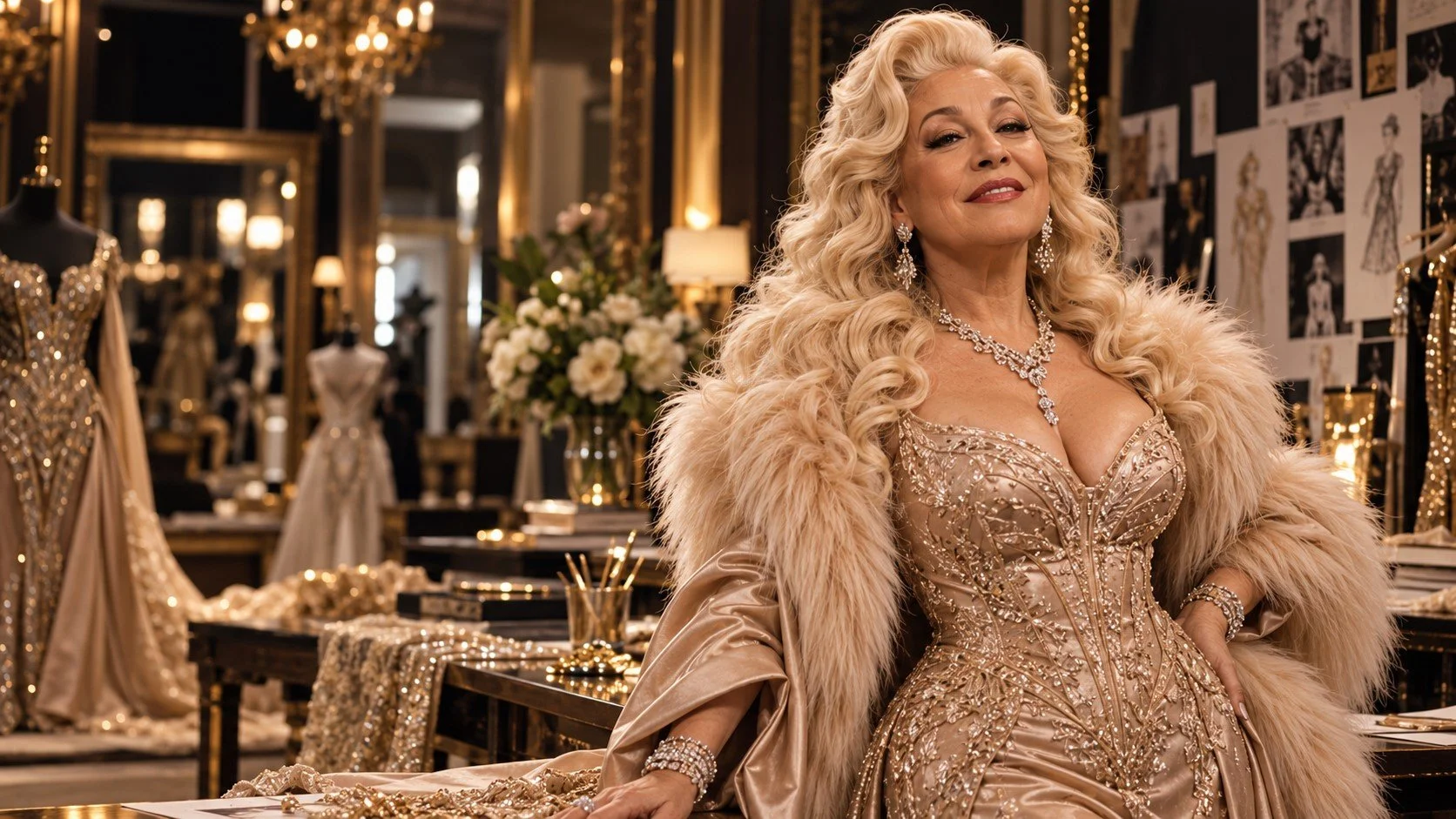
BEHIND THE CHARACTERS - EPISODE 04
Alita Sanlourant: Elegance as a Form of Power
Editor-in-chief of the most influential fashion magazine in the Three Kingdoms, undisputed queen of appearances, and an exceptionally demanding presence among the Seven Magnificent Dwarfs. Alita Sanlourant is far more than an insufferable diva. Beneath her obsession with style lies a question that concerns all of us: who gets to decide what's worthy of admiration? And why did I choose the tango to tell her story through music?
When the Seven Magnificent Dwarfs arrive on Earth, their first priority should be to avoid attracting attention.
They're in unfamiliar territory, carrying out a dangerous mission, and must do everything possible to remain unnoticed. That's why they've been equipped with disguises designed to help them blend into their surroundings.
Alita Sanlourant has a completely different problem.
She can't find the zipper that will release her from that hideous costume.
Moments later, while Henrietta desperately tries to remind her of their orders, Alita finally frees herself from the disguise and emerges in an elegant pink suit with blue trim.
It's a comic scene, of course. But it already contains almost everything I wanted to explore through this character.
For Alita, surrendering her appearance means surrendering part of her identity. It doesn't matter how dangerous the situation is or whether someone has issued an order. A woman like her simply cannot hide inside an outfit chosen by somebody else.
Especially when that outfit is in such appalling taste.
The issue, however, goes far beyond vanity.
Alita belongs to that particular category of people who don't merely follow social conventions. They help create them. She decides which clothes will become desirable, which colors will be indispensable, which behaviors will be considered elegant, and which people will be admitted into the circles that matter.
In other words, she possesses something many of her companions do not.
The power to determine how the world should appear in the eyes of others.
Alita Soffio Sanlourant: A Name, a Brand
The character's full name is Alita Soffio Sanlourant.
Her surname, with its unmistakable echo of the great French fashion houses, immediately places her within a culture where a name can become much more than a personal identity. It can become a brand.
In the novel, Alita is the feared editor-in-chief of Nanity Fair, the most influential fashion magazine in the Three Kingdoms. She moves through Gnomopolis's exclusive social circles, maintains privileged relationships with designers such as Giorgio Arnani, and collaborates with fashion labels bearing deliberately outrageous names like Nanace and Gnomo & Gabbana.
The comparison with Miranda Priestly from The Devil Wears Prada is hardly accidental. But while Miranda belongs to a world in which fashion quietly influences people's lives, Alita inhabits a fantasy universe where that influence reaches almost grotesque proportions.
Her readers wait to discover what's IN and what's OUT. Her opinions are received like verdicts. Her personal taste becomes a collective standard.
What interested me most was precisely this transformation: the moment when an individual's preference becomes a universal rule.
A color is no longer simply beautiful or ugly. It becomes right or wrong. An outfit no longer expresses only a personal choice. It establishes membership in a social class, an exclusive circle, a hierarchy.
Alita exercises this authority with absolute confidence, never questioning whether she has the right to do so.
She isn't simply a woman who loves clothes.
She's a woman who expects to control the social meaning of clothes.
And that's where, at least for me, the character starts becoming genuinely interesting.
When a Military Mission Becomes a Fashion Show
There's a detail in the novel that I consider essential to understanding Alita.
Her presence on the team isn't primarily the result of extraordinary military abilities or exceptional investigative skills.
Alita managed to join the mission because she controls something that makes countless ventures possible, including the noblest ones: funding.
She secured the sponsors.
The major fashion houses of Gnomopolis invested in the expedition in exchange for exposure, exclusive reporting, and commercial opportunities. The team's clothing, accessories, and even parts of its equipment become elements in an enormous promotional campaign.
What should be a mission to save the Three Kingdoms threatens to turn into a media event, a kind of interdimensional reality show financed by the fashion industry.
The situation is intentionally absurd.
But how far removed is it from our own reality?
We're accustomed to seeing sports, scientific research, culture, and even humanitarian initiatives accompanied by corporate logos, sponsorship agreements, and elaborate communication strategies. Money makes projects possible that might otherwise remain nothing more than good intentions. But those who provide the funding may also expect to influence how those projects are presented to the public.
Alita understands this mechanism perfectly.
She doesn't possess Yul's strength, Vik's ability to manipulate illusions, or Teo-Bomb's extraordinary powers. What she possesses is considerably more ordinary, but not necessarily less effective: a network of influential relationships, an audience, and the ability to transform almost any event into a media product.
When she demands time to photograph the underground wonders of Ebenezer's base, the others regard her as an intolerable obstacle. And at that particular moment, they're right. There's an imminent threat, a countdown underway, and stopping to organize a fashion shoot would be irresponsible.
But Alita has an argument they cannot entirely dismiss: without her sponsors, the operation wouldn't have had the same resources.
That's her real power within the team.
Alita exposes the conflict between what a mission needs to accomplish and what its financial backers want the world to see.
It's a contradiction that even the wise Teo-Bomb cannot entirely escape.
Henrietta and Alita: Two Incompatible Ways of Living
One of the relationships I most enjoyed developing is the one between Alita and Henrietta Cole.
The two women represent almost opposite approaches to life.
Henrietta is a hunter, an exceptional marksman, and a woman accustomed to wilderness environments and the practical demands of survival. Her relationship with animals and nature is profound, direct, and free from unnecessary ceremony.
For Henrietta, clothing should first and foremost allow someone to move, work, fight, and withstand difficult conditions.
For Alita, clothing communicates who you are, what position you occupy, and how you want others to perceive you.
One sees clothes as tools.
The other sees them as a language.
Neither is particularly willing to accept the other's point of view.
Alita finds Henrietta's lack of elegance unbearable, while Henrietta considers her companion superficial, arrogant, and incapable of distinguishing what matters from what doesn't.
Their arguments are often savage, grotesque, and spectacularly undiplomatic. But they also expose a conflict that reaches far beyond fashion.
What matters more: what we're capable of doing, or how other people see us?
Henrietta would answer without hesitation that actions are what count.
Alita would probably argue that actions, unless properly presented, may never receive the recognition they deserve.
And both, at least to some extent, would have a point.
But there's an episode that prevents their relationship from becoming a simple confrontation between practicality and vanity.
It's the story of Polpetta.
The Gift Alita Was Never Expected to Give
While exploring the Blackrain estate, Henrietta and Alita come across a small statue of a dog.
His name is Polpetta.
Henrietta has recently lost her own dog, and the sight of the stone figure brings back the pain of that loss.
Alita could ignore it. She could dismiss the situation with one of her poisonous remarks and return to worrying about her appearance.
Instead, she does something unexpected.
She reaches into her designer handbag and produces a small bottle containing a glowing purple liquid, obtained through one of her many connections in the fashion world. It's an unusual substance, acquired through decidedly unofficial channels, capable of restoring life to a petrified creature.
Alita uses it on Polpetta.
Moments later, the dog begins moving again, wagging his tail and running toward Henrietta.
Alita gives him to her.
I consider this scene important because it reveals something the character ordinarily goes to considerable lengths to conceal.
Behind the woman who judges others by their appearance is someone capable of recognizing another person's pain and responding with a meaningful gesture.
Not a speech about compassion.
Not a public declaration intended for the readers of her magazine.
A gift.
Naturally, Alita doesn't abandon her usual personality. She insists that Henrietta keep the incident secret and concludes the encounter with one of her customary cutting remarks.
It would be far too easy to transform her suddenly into a generous, flawless woman.
She isn't one.
But that brief opening reveals an emotional complexity that her public image usually keeps hidden.
And there's something particularly meaningful about the fact that Alita, a woman obsessed with surfaces, is the one who manages to see beyond the motionless appearance of a stone statue.
The Secret Beneath the Makeup
Any character who builds an identity around an image of perfection must eventually confront something that cannot be controlled.
In Alita's case, I chose a decidedly inelegant solution.
The most sophisticated authority on fashion in Gnomopolis suffers from absolutely dreadful bad breath.
Her middle name, Soffio, which means breath or puff in Italian, makes the whole thing even more ironic.
Alita devotes enormous energy to concealing this flaw. Mouthwash, elaborate precautions, constant attempts to prevent other people from discovering the truth. Her public image must remain immaculate.
The comedy comes naturally from the contrast between the sophisticated queen of etiquette and a physical imperfection that seems determined to resist every attempt at control.
But the episode also suggests another interpretation.
Alita is a prisoner of the very standards of perfection she imposes on everybody else.
She has built a system in which any imperfection can become grounds for judgment, ridicule, or exclusion. Now she lives in fear that the same system will be turned against her.
It's the paradox of someone whose prestige depends on standards that no human being can meet completely.
The public persona must always appear flawless, even when the real person is inevitably imperfect.
In that sense, Alita may actually be less free than Henrietta, who feels no need to ask anyone's permission to be herself.
I doubt Alita would appreciate that interpretation.
She'd probably place me immediately on her list of OUT authors.
When the Diva Sees More Clearly Than the Soldier
It would be unfair, however, to describe Alita solely through her comic contradictions.
At certain moments in the novel, she demonstrates a capacity for judgment that other members of the team, despite being better trained for the mission, seem to have temporarily lost.
When Yul becomes convinced that Johnas Blackrain is involved in the crimes they're investigating, Alita is among those who question his certainty.
She points out that Blackrain has never been given a genuine opportunity to explain his position and that the team has chosen aggression before attempting to understand the situation.
Naturally, even at that moment, she manages to imagine organizing a campaign among the readers of her magazine.
That's typical Alita. Even a question of justice can become an editorial initiative.
But it doesn't make her observation wrong.
Alita, who spends much of her life judging appearances, recognizes that her companions are in danger of condemning someone based on appearances alone.
It's an irony I particularly enjoy.
The character who seems the most superficial is, in that moment, capable of recognizing a superficiality far more dangerous than choosing the wrong outfit.
Perhaps it's because she understands better than the others how powerfully an image can influence people's judgment.
Or perhaps, simply because she isn't a soldier, she feels no obligation to defend Yul's initial interpretation of events at any cost.
Whatever the explanation, Alita demonstrates that her intelligence cannot be measured solely by her obsession with fashion.
The problem is that she frequently makes it difficult for anyone to take her seriously.
Why the Tango?
When I began imagining a musical identity for Alita within The Blackrain Session, the obvious choice might have been an elegant, sophisticated pop song, perhaps with a glittering chorus designed to conquer the music charts of Gnomopolis.
But that would have been too predictable.
Alita isn't simply a celebrity who wants to be admired. She's a woman who expects to control the entire scene.
To represent that particular form of power, I needed music capable of expressing elegance, tension, sensuality, pride, and conflict.
I chose the tango.
The tango possesses a quality that makes it especially suitable for Alita: its elegance doesn't eliminate conflict. It organizes it.
In a tango, physical closeness can become a challenge. One step suggests an intention, the next contradicts it. The dancers seem to communicate through hesitation, advances, sudden pauses, and changes of direction.
There's a constant negotiation between control and surrender.
And Alita, who rarely tolerates being contradicted in her professional life, belongs perfectly in that world.
But there's another reason the tango felt right.
In its theatrical form, the tango can turn the simple act of crossing a room into a declaration of superiority.
An entrance becomes a challenge.
A glance becomes an order.
A movement becomes a signature.
That's exactly how I imagine Alita walking into a room.
She doesn't walk.
She makes an entrance.
The Fashion Diva Tango: When Fashion Follows Alita
The song is called The Fashion Diva Tango.
It doesn't attempt to recount the character's entire history. Instead, I wanted to concentrate on her public identity, allowing Alita herself to introduce her personality with the confidence of someone who has never seriously questioned her own superiority.
The central idea is expressed in the chorus:
“I don't follow fashion, darling. Fashion follows me.”
It's an almost imperial declaration.
Alita doesn't consider herself an interpreter of trends. She considers herself their source.
In the lyrics, she celebrates her ability to create styles destined to be imitated, presents Gnomopolis as a territory over which she exercises unquestioned authority, and treats her rivals as unfortunate figures condemned to remain hopelessly behind.
Then she extends that vision to the mission of the Seven Magnificent Dwarfs.
The journey to Earth, financed by major fashion houses, becomes another opportunity to carry her creations beyond the boundaries of the known world.
Even an expedition intended to save an entire civilization can be reinterpreted as the launch of a new collection.
The song therefore returns to one of the novel's most important satirical elements: the way commercial communication can appropriate events that, at least in theory, should serve entirely different purposes.
But it does so through the protagonist's own voice.
Alita sees absolutely nothing objectionable about this arrangement.
Quite the opposite.
She's proud of it.
In her view of the universe, heroes may accomplish extraordinary deeds, but somebody still has to make sure they look good while doing them.
And preferably remind the audience who designed the clothes they're wearing.
The tango amplifies this narcissism and transforms it into spectacle. The theatrical quality of the vocals, the dramatic character of the music, and the sound of the bandoneón create an environment in which Alita can finally occupy all the space she desires.
She doesn't have to argue with Henrietta.
She doesn't have to obey Yul.
She doesn't have to justify herself to Teo-Bomb.
For the duration of the song, she's free to become the most exaggerated, arrogant, and fascinating version of herself.
And that's precisely why the song works.
Behind Perfection, a Person
There's a question that keeps returning whenever I think about Alita Sanlourant.
What would remain of her if nobody could admire her anymore?
If her magazine ceased to exist, if the major fashion houses turned their backs on her, if the public no longer needed to know what was IN or OUT?
Would Alita still be the same person?
I don't believe the novel offers a definitive answer. Nor was that ever my intention.
I'd rather allow readers to observe the character's contradictions for themselves.
A woman capable of jeopardizing a mission to arrange a photo shoot, yet also capable of recognizing an injustice that others refuse to acknowledge.
A diva who humiliates a companion over her clothes and shortly afterward gives her a dog because she understands how much happiness that gesture can bring.
A figure who builds her authority on aesthetic perfection while living in terror that someone might discover a flaw she cannot completely conceal.
She isn't a role model.
And I wouldn't want her to become one.
Her arrogance, vanity, and inability to recognize other people's priorities are as much a part of her as her intelligence, resourcefulness, and occasional moments of genuine sensitivity.
Alita is a caricature, certainly. But caricatures work when they exaggerate something we recognize in real life.
And in real life, the distance between the need to impress others and the desire to be genuinely appreciated is often much smaller than we're willing to admit.
Perhaps, beneath the layers of makeup, behind the impeccable suit and beyond the confidence she displays so effortlessly, Alita longs for something that prestige cannot purchase and a fashion verdict cannot command.
To be appreciated even when she isn't perfect.
We don't know whether she'll ever allow herself that possibility.
For now, though, I imagine her standing in the center of a ballroom. The bandoneón begins to play, the lights dim, and every eye turns toward her.
Alita smiles, adjusts her collar ever so slightly, and prepares to take the first step.
Because one thing is certain.
Fashion may change. But Alita Sanlourant has absolutely no intention of following it.
Listen to Alita Sanlourant — The Fashion Diva Tango
Another character from The Seven Magnificent Dwarfs finds her musical voice in The Blackrain Session, the project that brings the novel's protagonists beyond the printed page.
ALITA — THE FASHION DIVA TANGO
GNOME RECORDS · THE BLACKRAIN SESSION
Discover The Seven Magnificent Dwarfs on Amazon
Behind the Characters is a series exploring the identities, contradictions, and musical interpretations of the protagonists of The Seven Magnificent Dwarfs. The Blackrain Session is a creative project conceived and directed by Andrea Bigiarini, using generative artificial intelligence tools to bring the characters' musical personalities to life.
Andrea Bigiarini