
THE HIDDEN ORDER OF CHAOS
A Critical Reading of The Seven Magnificent Dwarfs by Andrea Bigiarini
By Wandoo Karlestein, Gnomopolis
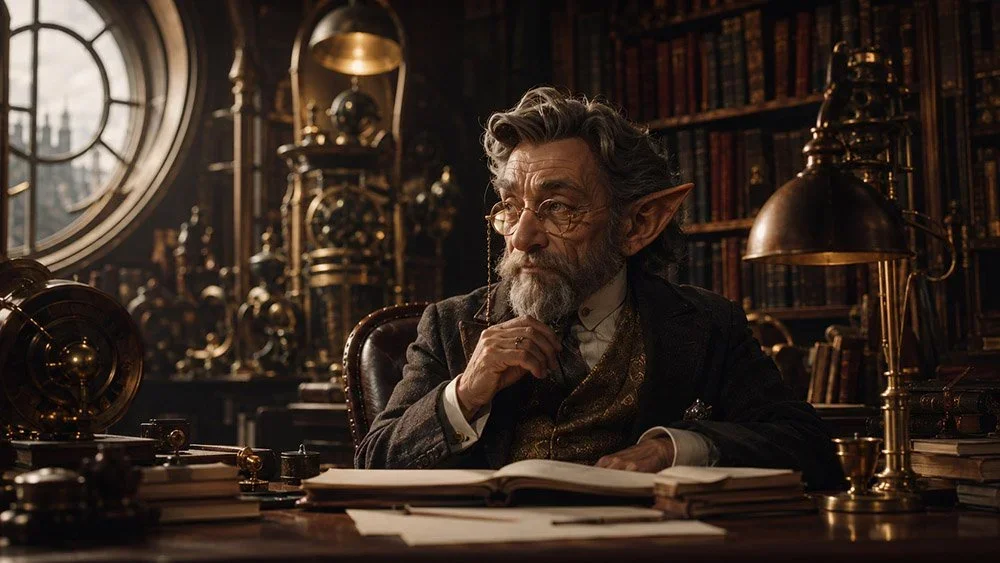
Wandoo Karlestein
There are novels in which style is simply the vehicle used to tell a story, and there are novels in which style eventually becomes part of the story itself.
The Seven Magnificent Dwarfs belongs firmly to the second category.
Andrea Bigiarini builds a narrative universe that seems to move through accumulation, detours, and accidents. The story advances, stops, starts again, wanders into what appears to be an entirely irrelevant observation, pauses to explain how a weapon works, the psychology of a character, the commercial name of a device, the political history of a kingdom, or the behavior of some highly improbable creature—and then suddenly returns to wherever it started.
On a superficial reading, one might call this disorder.
That would be a mistake.
What Bigiarini creates is something closer to controlled chaos.
The novel constantly gives the impression that it is about to burst through its own boundaries, yet it rarely loses its direction. Digression is not an obstacle to the story. It is one of its engines. Every detour adds something to the universe, the tone, or our perception of the characters.
Instead of moving forward along a straight line, the story expands.
That is an important distinction.
The Narrator Who Refuses to Stay Invisible
The novel’s first decisive choice is, naturally, its narrative voice.
Bigiarini rejects the idea of the transparent narrator, politely concealed behind events.
His narrator wants to be there.
He interrupts.
Judges.
Foreshadows.
Mocks.
Philosophizes.
Speaks directly to the reader.
At times he seems to know every law governing the universe. At others, he behaves like an irritated witness who resents the fact that he has been forced to tell the story in the first place.
And, most importantly, he has a body.
A body made of sugar.
This could have been nothing more than a surreal joke.
It is not.
The narrator of The Seven Magnificent Dwarfs enters the story already threatened by obsolescence. He knows that the material from which he is made is temporary. That sooner or later he will be removed, eaten, discarded, or simply cease to matter.
Narration therefore becomes a form of resistance against disappearance.
It is an unexpectedly coherent idea within one of the novel’s deeper themes: the conflict between form and identity.
Statues become creatures. Living beings become objects. There are automatons, copies, mutations, and parallel universes.
In a novel obsessed with the question What makes a thing what it is?, even the narrator is trapped inside an apparently absurd form.
The comedy conceals a conceptual structure far deeper than the opening tone might suggest.
Hyperbole as a Unit of Measurement
Bigiarini seems to have a genuine distrust of any adjective that has not been pushed at least several miles beyond what is strictly necessary.
If a house is large, it must be enormous.
If someone is rich, the wealth must be offensive.
If a character is irritated, simple irritation will not do. The entire world must be informed through a chain reaction of images, comparisons, and wildly disproportionate consequences.
And when something explodes, it rarely has the courtesy to simply explode.
Hyperbole may well be the fundamental rhetorical device of The Seven Magnificent Dwarfs.
But what matters is how it is used.
Exaggeration does more than generate comedy.
It defines character.
Blackrain Estate is enormous because Johnas’s need to separate himself from the world is enormous.
His collection is excessive because the emptiness he attempts to fill with objects is equally excessive.
His routines are obsessively precise because they form a dam against the unexpected.
External excess almost always corresponds to internal excess.
This is where Johnas Blackrain proves to be particularly well constructed.
At first, he may appear to be little more than a caricature: a misanthropic billionaire, arrogant, class-conscious, obsessive, and almost intolerable.
But Bigiarini uses that caricature as camouflage.
The more grotesque Johnas appears, the more effective the gradual discovery of his fragility becomes.
The comedy does not erase the melancholy.
It protects it.
The Bigiarini Simile
The novel’s similes deserve a category of their own.
Traditionally, a simile is supposed to clarify an image by comparing it with something familiar.
Bigiarini frequently does the opposite.
He begins with something perfectly understandable and compares it to something even more absurd.
The result is a kind of expansion of the image.
A character cannot simply run very fast.
That would be insufficiently interesting.
He has to run like something whose logic, speed, or sheer semantic incompatibility creates an entirely new scene in the reader’s mind.
The simile stops being decoration and becomes a miniature story.
For a few seconds, the novel abandons whatever it was talking about, creates a tiny parallel reality, extracts the comic effect from it, and then returns.
It is the same principle on which the entire novel operates, reproduced on a smaller scale.
The detail contains the method of the book.
The Pleasure of Accumulation
Bigiarini’s prose loves lists.
Titles.
Objects.
Technical specifications.
Numbers.
Brands.
Regulations.
Dates.
Paragraph numbers.
Devices.
Institutions.
Military terminology.
Classifications.
The effect is deliberately excessive.
Everything seems to have an acronym, a history, a manufacturer, a Mark II version, or some government regulation explaining exactly how it may legally be used.
It is one of the novel’s most effective mechanisms because it applies bureaucratic solemnity to complete absurdity.
A dwarf carrying an impossible weapon does not simply carry a cannon.
He carries something whose official designation sounds as if it required the combined efforts of a Ministry of Defense, a patent office, and an advertising department.
The fantastic is therefore normalized through bureaucracy.
It is a clever choice.
The author does not spend his time trying to persuade us that his world is extraordinary.
He does precisely the opposite.
He shows us characters for whom the absurd is simply administrative routine.
And that is exactly why we begin to believe in it.
Language as World-Building
Gnomopolis and the Three Kingdoms are not constructed solely through architecture or historical exposition.
They are constructed through language.
Nanity Fair.
Gnomo & Gabbana.
Dimensi-O-Rama.
Loc-A-Tronic.
Grand Incontestable.
Highly Malevolent Creatures.
Wars of Reunification.
The novel has what can only be described as an obsession with naming.
Everything needs a name, and the name itself must already tell us something about the culture that invented it.
Through these names, we understand that Gnomopolis is simultaneously a technologically advanced civilization, a bureaucratic society, a consumer culture, a political system, a media-saturated world, and a place where magic and technology stopped regarding one another as incompatible a very long time ago.
World-building, therefore, is not confined to descriptive passages.
It is scattered throughout the language itself.
The Genre Problem
Trying to classify The Seven Magnificent Dwarfs is an interesting exercise.
It is also probably useless.
Fantasy?
Certainly.
Science fiction?
Equally certainly.
Comedy?
Undeniably.
Satire?
Everywhere.
Adventure?
Its primary structure.
A love story?
Far more than the reader initially suspects.
Bigiarini does not appear particularly interested in resolving these contradictions.
He prefers to let them coexist.
And this is one of the most distinctive aspects of the novel.
A scene may begin as military science fiction, turn into bureaucratic comedy, wander into a philosophical observation, and end on a note of melancholy.
The obvious risk is tonal dissonance.
But the novel gradually turns that dissonance into its own grammar.
After a certain number of pages, the reader stops asking what register will come next.
The reader simply accepts that almost anything might.
Laughing Without Destroying Emotion
Perhaps the most difficult challenge in writing this kind of novel is preserving genuine emotion.
Constant irony can become corrosive.
If everything is mocked, eventually nothing can be taken seriously.
Bigiarini largely avoids this trap by establishing an implicit rule:
the characters may be ridiculous without their emotions necessarily being ridiculous.
Johnas is ridiculous.
His pain over Alma is not.
Yul can become comic through his obsessive military discipline, yet the sense of duty driving him remains genuine.
Gnomopolis may overflow with absurd names, advertising, fashions, and grotesque bureaucracy, but the political crisis consuming it has real consequences.
That balance prevents the novel from becoming a permanent parody.
The joke does not cancel the tragedy.
And the tragedy does not prevent the next joke.
A Prose Style That Has No Desire to Behave
There is one final element I believe is essential to understanding Bigiarini.
This is not prose that aspires to polished elegance.
It does not seek the invisible sentence, perfectly measured and sterilized of every eccentricity.
On the contrary, it appears suspicious of prose that behaves too well.
It prefers to accumulate.
To insist.
To repeat.
To exaggerate.
To interrupt.
To add one more thing precisely where more disciplined prose would already have placed the period.
That is exactly where its identity lies.
Naturally, it is also where its greatest risk lies.
A reader seeking absolute economy, minimalism, or rigidly linear storytelling may experience this abundance as excessive.
But asking The Seven Magnificent Dwarfs to become more restrained would probably mean asking it to become a different book.
Its style lives on the same energy that governs its universe: objects concealing other forms, worlds inside other worlds, explanations generating further explanations, accidents opening unexpected possibilities.
The novel does not simply move forward.
It proliferates.
And perhaps that is the single best word to describe Andrea Bigiarini’s writing.
Conclusion
The Seven Magnificent Dwarfs is a novel that constantly appears to be on the verge of losing control—and draws much of its vitality from that very sensation.
Its prose is hyperbolic, digressive, metanarrative, crowded, ironic, and deliberately impure.
It mixes popular culture, science fiction, social satire, bureaucracy, sentimentality, philosophy, slapstick, and adventure without asking permission from any of the genres it passes through.
Yet beneath this noisy surface lies a surprisingly coherent architecture.
Form and substance.
Order and chaos.
Appearance and identity.
Stasis and change.
These oppositions run through both the story and the way the story is told.
Johnas Blackrain desperately tries to organize a life in which everything has its proper place.
Andrea Bigiarini, with a certain degree of cruelty, builds a novel around him in which absolutely nothing agrees to remain where it belongs.
Perhaps that is the best possible definition of the style of The Seven Magnificent Dwarfs:
an apparently anarchic form of storytelling in which chaos is not the absence of order, but an order that is simply much harder to see.
Wandoo Karlestein
Literary Critic — Gnomopolis
The world of The Seven Magnificent Dwarfs begins here
→ Discover the novel on Amazon
Paperback: https://www.amazon.com/dp/B0HK4L59H2
Kindle: https://www.amazon.com/dp/B0HJZPTN61
Wandoo Karlestein is one of Gnomopolis’s most respected literary critics, known for his rigorous analysis of contemporary fiction and his particular interest in style, narrative voice, and the hidden mechanisms operating beneath the apparent chaos of a text.
He contributes to several of the Three Kingdoms’ leading cultural publications and is known for his severe tone, dry irony, and very limited tolerance for conventional fiction.